
/ en / work / alphapilot
AlphaPilot — Controlled Agentic Investment Research
Multi-agent research and paper-trading validation behind deterministic risk, approval and audit controls
→ Business impact: Split architecture agents / risk engine — hard kill switch · paper validation before real capital.
- Client
- Independent research — publicly documented
- Role
- Architect & lead engineer
- Period
- 2025 → today
- Status
- paper-trading
- v1.5.0 shipped
- 608 tests
- 95 % coverage
- ✓ kill switch
Business context
Independent research: prove a multi-agent system can run autonomous investment research without ever bypassing a deterministic risk control.
Constraints
- Probabilistic reasoning isolated from execution
- No order without Risk Engine validation
- Kill switch with priority
- Paper validation before any capital
Architecture
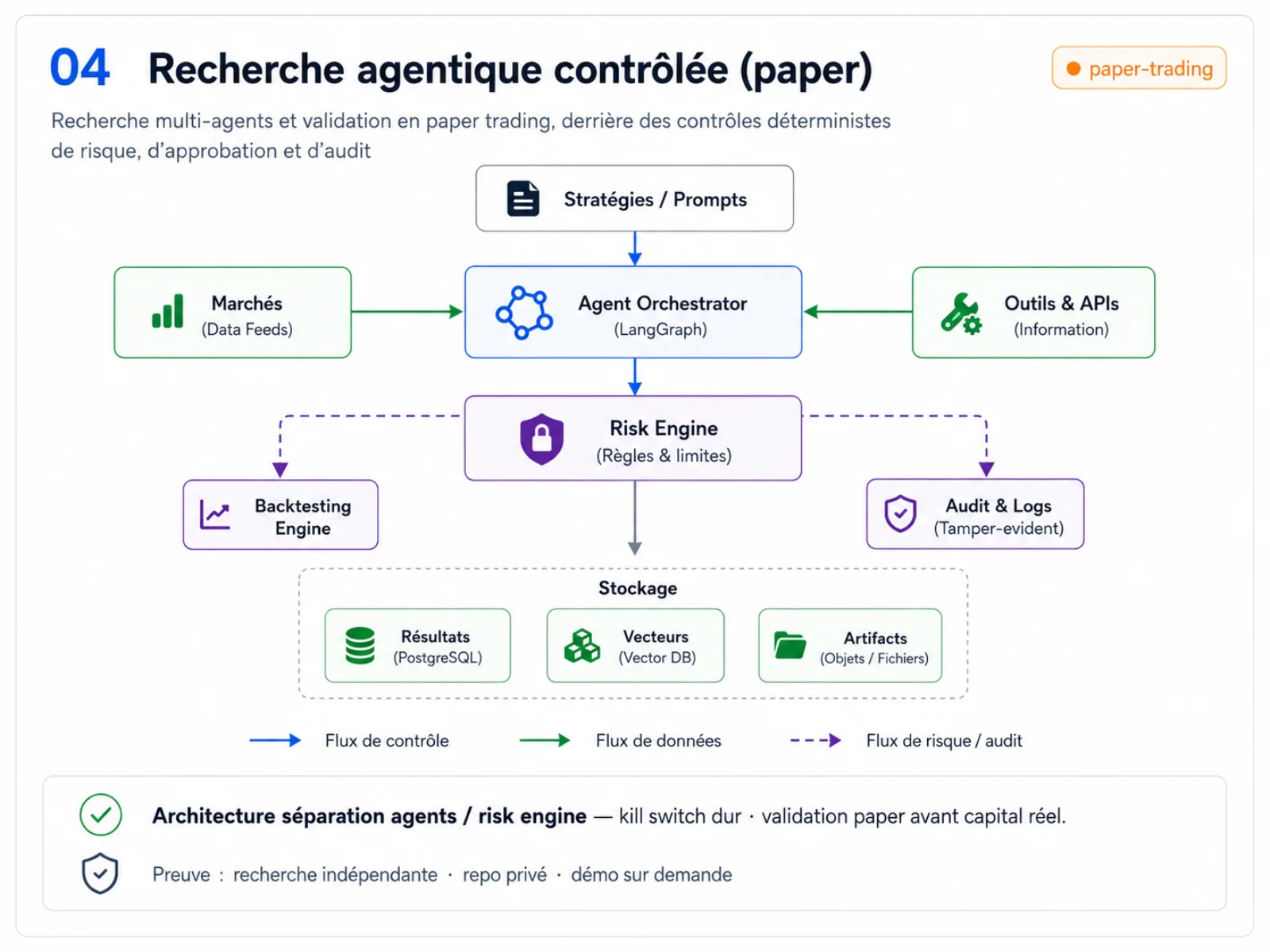
Architecture diagram — anonymised
Components: Python · LangGraph · FastAPI · Supabase
Decision workflow
Agents analyse and propose; the deterministic Risk Engine validates or rejects; every decision is logged. The kill switch cuts everything, with absolute priority.
Key architecture decisions
- Hard boundary between probabilistic agents and deterministic execution
- Kill switch above all logic
- Paper trading as a mandatory validation stage
My contribution
- Full system architecture (18 agents + Risk Engine)
- 608 tests, 95% coverage on critical paths
- Paper validation pipeline
Outcomes
- v1.5.0 shipped — no order bypasses the Risk Engine
- Deterministic boundary demonstrated and tested
- Foundation ready for V2 (real capital after review)
Confidentiality
Private repo (trading logic) — architecture and results documented publicly, demo on request.
Learnings
- Reliability comes from the boundary, not from agent intelligence.
- A kill switch only matters if it has priority and is tested.
🚧 V-next — already in the works
This system ships continuously — the next stages are already on the bench. Come back to check the status, or ask the agent where it stands.
- Real-capital trading support — arrives in V2, behind a dedicated risk review.
- Unified broker contract already wired — real-capital activation planned for V4.
- Per-strategy performance attribution — in development for V2.