
/ en / work / cs-data-platform
Dataiku — Shared Data Science Platform Blueprint
A practical reference for environment separation, deployment standards, monitoring and support
→ Key learning: A reusable way to reason about reliable shared data-science platforms, governance boundaries and operating responsibilities.
- Context
- Independent educational reference
- Contribution
- Pattern synthesis and architecture explanation
- Period
- Living reference
- Status
- in-development
- dev · test · prod pattern environments
- by design separation
- monitoring + runbooks operations
- reusable standards
What this reference explains
This case study shares how I understand the design of a mutualised Dataiku platform. It is a generic learning resource built from public concepts and transferable engineering patterns. It does not identify an employer or client, reproduce an internal architecture, or claim that this exact design is running in any company.
Design constraints
- Separate experimentation from controlled releases
- Make promotion between environments explicit
- Treat security, monitoring and support as platform capabilities
- Give teams reusable standards instead of one-off configurations
Reference architecture
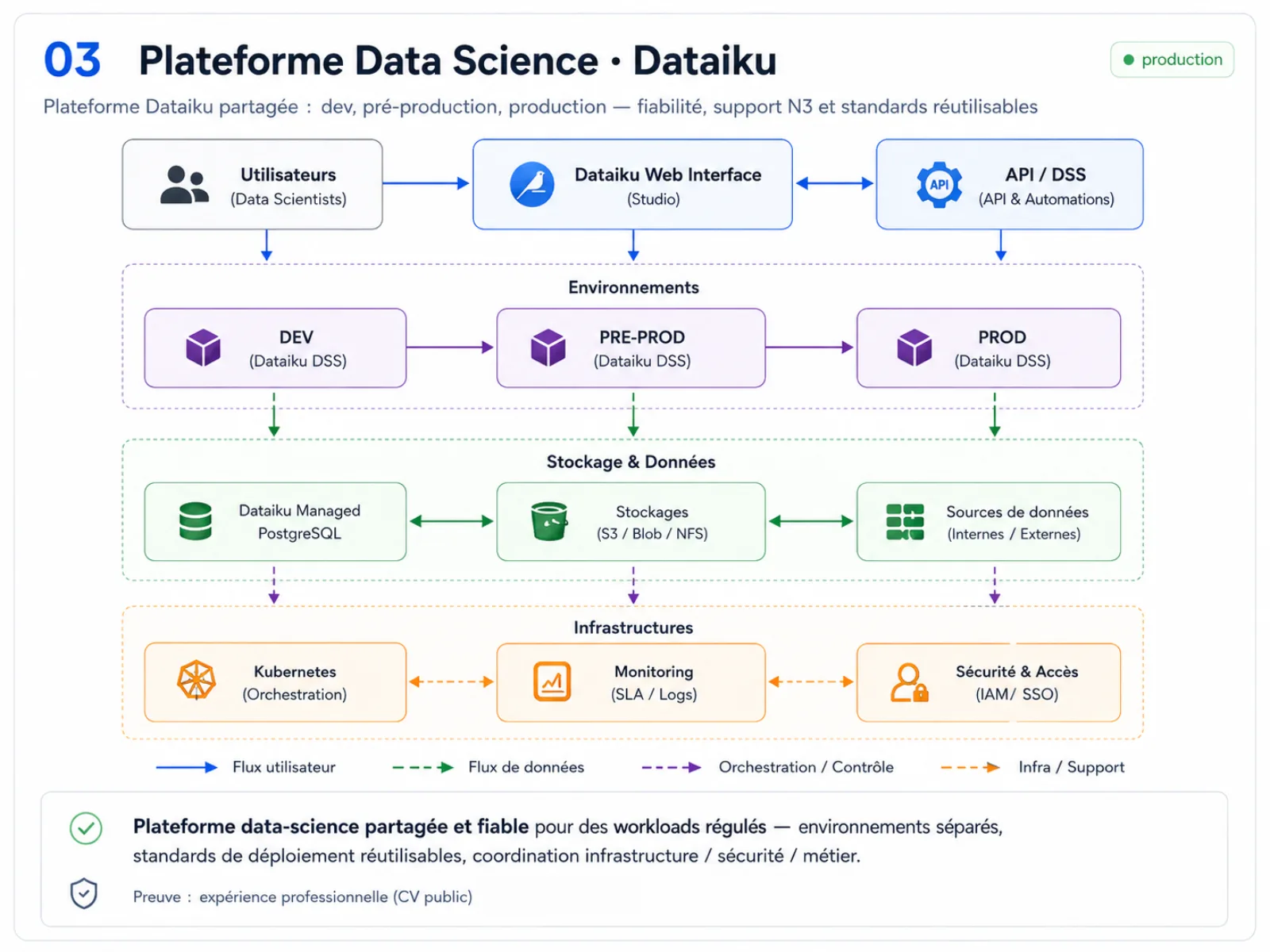
Conceptual reference diagram — not a representation of a company system
Building blocks: Dataiku · Kubernetes · Python · monitoring · deployment standards
How the pattern works
Projects begin in a development environment. Tests and release checks form a controlled promotion path toward a production-like environment. Monitoring, incident runbooks and ownership rules sit around that path so operating the platform is considered from the start.
Key design choices
- Isolate environments and credentials
- Version reusable deployment recipes
- Define observability and support responsibilities before onboarding teams
- Keep platform controls consistent while allowing project-level iteration
What I know how to reason about
- Environment topology and promotion paths
- Dataiku project packaging and deployment standards
- Kubernetes-backed execution boundaries
- Monitoring, incident analysis and support models
- Onboarding guidance for shared-platform users
Community takeaway
A shared platform succeeds through clear boundaries, repeatable releases and an operable support model—not through features alone.
Disclosure boundary
This page contains no proprietary code, internal documents, confidential metrics or company-specific topology. It is educational material, not proof of a production deployment.
🚧 V-next — already in the works
This system ships continuously — the next stages are already on the bench. Come back to check the status, or ask the agent where it stands.
- This is a generic reference model, not a disclosure of a deployed company system.